


In an era increasingly defined by technological leaps, the conversation around artificial intelligence often oscillates between utopian visions and dystopian fears. However, a more nuanced and powerful paradigm is emerging: Augmented Intelligence. This groundbreaking approach redefines the relationship between humans and machines, moving beyond mere automation to create a synergistic partnership. Instead of AI replacing human intellect, Augmented Intelligence focuses on enhancing human capabilities, providing tools that amplify our cognitive functions, decision-making processes, and creative potential. This isn't about machines taking over; it's about intelligent systems working alongside us, making us smarter, more efficient, and more capable. The question on everyone's mind is: What Is Augmented Intelligence? The Future of AI-Human Collaboration. At MetanexusXR, we believe this human-centric AI is not just a concept but the very foundation of future innovation, especially when integrated with immersive Extended Reality (XR) technologies.
Unpacking What Is Augmented Intelligence? The Future of AI-Human Collaboration
Augmented Intelligence (AIg) stands in stark contrast to the pursuit of Artificial General Intelligence (AGI), which aims to create machines with human-like consciousness and broad cognitive abilities. Instead, AIg is purpose-built to complement human strengths, addressing our limitations with machine precision and speed. It's a design philosophy centered on human oversight, ensuring that while AI systems process vast datasets, identify patterns, and offer predictions, the ultimate decision-making power remains firmly in human hands. This partnership leverages the best of both worlds: the AI's unparalleled ability to analyze complex data at scale, and the human's unique capacity for creativity, critical thinking, emotional intelligence, and ethical reasoning.
Key Features and Technical Specifications of Augmented Intelligence
The efficacy of Augmented Intelligence hinges on several core technological components and design principles:
- Advanced Machine Learning Algorithms: These form the backbone, enabling AIg systems to learn from data, identify intricate patterns, and make highly accurate predictions or recommendations. This includes supervised, unsupervised, and reinforcement learning techniques tailored for specific tasks.
- Natural Language Processing (NLP): Essential for seamless human-AI interaction, NLP allows systems to understand, interpret, and generate human language, facilitating intuitive communication through voice commands, text analysis, and intelligent summarization.
- Computer Vision: Critical for applications involving visual data, computer vision enables AIg systems to 'see' and interpret images and videos, identifying objects, faces, and even complex scenes. This is particularly vital for XR integration.
- Data Analytics and Visualization Engines: AIg systems excel at processing massive datasets, extracting meaningful insights, and presenting them in easily digestible formats, often through interactive dashboards or immersive visualizations, allowing humans to grasp complex information rapidly.
- Adaptive Learning and Personalization: These systems are designed to learn from individual user interactions, preferences, and feedback, continuously refining their assistance to become more relevant and effective over time.
- Explainable AI (XAI): A crucial feature, XAI ensures that AIg systems can articulate their reasoning and the basis of their recommendations, fostering trust and allowing humans to understand and validate the AI's output.
- Integration APIs and Middleware: For AIg to be truly augmentative, it must integrate seamlessly into existing human workflows and software ecosystems, providing real-time assistance without disrupting productivity.
Benefits of Embracing Augmented Intelligence
The adoption of Augmented Intelligence offers a multitude of tangible benefits across various sectors:
- Enhanced Decision-Making: By providing data-driven insights and predictions, AIg empowers humans to make more informed, accurate, and timely decisions, reducing uncertainty and risk.
- Increased Efficiency and Productivity: AIg automates repetitive, data-intensive, or mundane tasks, freeing up human professionals to focus on higher-value, creative, and strategic work.
- Improved Accuracy and Reduced Errors: AI systems can process and cross-reference information with a level of precision that far surpasses human capabilities, significantly reducing the potential for human error.
- Unlocking Human Potential: By taking on routine tasks and providing intelligent assistance, AIg allows humans to leverage their unique skills in areas like innovation, empathy, and complex problem-solving.
- Personalized Experiences: From education to customer service, AIg can tailor interactions and content to individual needs, leading to more engaging and effective outcomes.
Augmented Intelligence in Extended Reality (XR) Environments
The synergy between Augmented Intelligence and Extended Reality (XR) – encompassing Virtual Reality (VR), Augmented Reality (AR), and Mixed Reality (MR) – represents a frontier of human-machine collaboration. XR provides the immersive interface through which AIg can deliver its insights and assistance in the most intuitive and impactful ways. Imagine wearing a pair of AR glasses and having an AI assistant overlay critical information directly onto your field of vision, or stepping into a VR environment where an AI guides you through complex simulations.
Revolutionary XR Use Cases Enhanced by Augmented Intelligence: The Future of AI-Human Collaboration
The integration of AIg with XR opens up transformative applications:
- Healthcare and Medical Training: Surgeons could use AR headsets where AIg highlights anatomical structures, identifies anomalies in real-time during surgery, or provides step-by-step procedural guidance. In VR, medical students can practice complex operations with AI-powered virtual patients that adapt to their actions, offering personalized feedback on technique and decision-making. Explore advanced VR accessories for medical training on MetanexusXR's VR accessories page.
- Industrial Maintenance and Field Service: Technicians in the field can wear AR glasses that project AIg-generated diagnostic information, repair instructions, and schematics directly onto equipment. The AI can analyze sensor data, identify potential failures, and guide the technician through complex repairs, significantly reducing downtime and improving first-time fix rates.
- Architecture, Engineering, and Construction (AEC): Designers can use VR to walk through AIg-optimized building models, with the AI highlighting structural weaknesses, energy inefficiencies, or code violations in real-time. In AR, construction workers can overlay digital blueprints onto physical sites, guided by AIg to ensure precise placement and identify potential clashes.
- Education and Training: AIg-powered virtual tutors within VR classrooms can adapt learning paths to individual student needs, providing interactive lessons, simulating historical events, or conducting scientific experiments in a safe, immersive environment. The AI can assess performance and offer tailored exercises. Find the right gear for immersive learning at MetanexusXR's full collection.
- Retail and E-commerce: Augmented Reality apps, driven by AIg, allow customers to virtually 'try on' clothes or place furniture in their homes. The AI can then offer personalized recommendations based on style preferences, fit, and even room decor, enhancing the shopping experience. For cutting-edge devices to power these experiences, check out MetanexusXR's VR accessories.
- Creative Design and Prototyping: Artists and designers can leverage AIg in VR to rapidly iterate on concepts, with the AI suggesting variations, optimizing aesthetics, or even generating entire scenes based on initial sketches. This accelerates the creative process and allows for exploration of possibilities that would be impossible manually.
The convergence of Augmented Intelligence and XR is not just about making technology smarter; it's about making humans smarter, more capable, and more connected to their work and the world around them. It represents a future where technology truly serves as an extension of human intellect, fostering innovation and solving complex challenges with unprecedented efficiency.
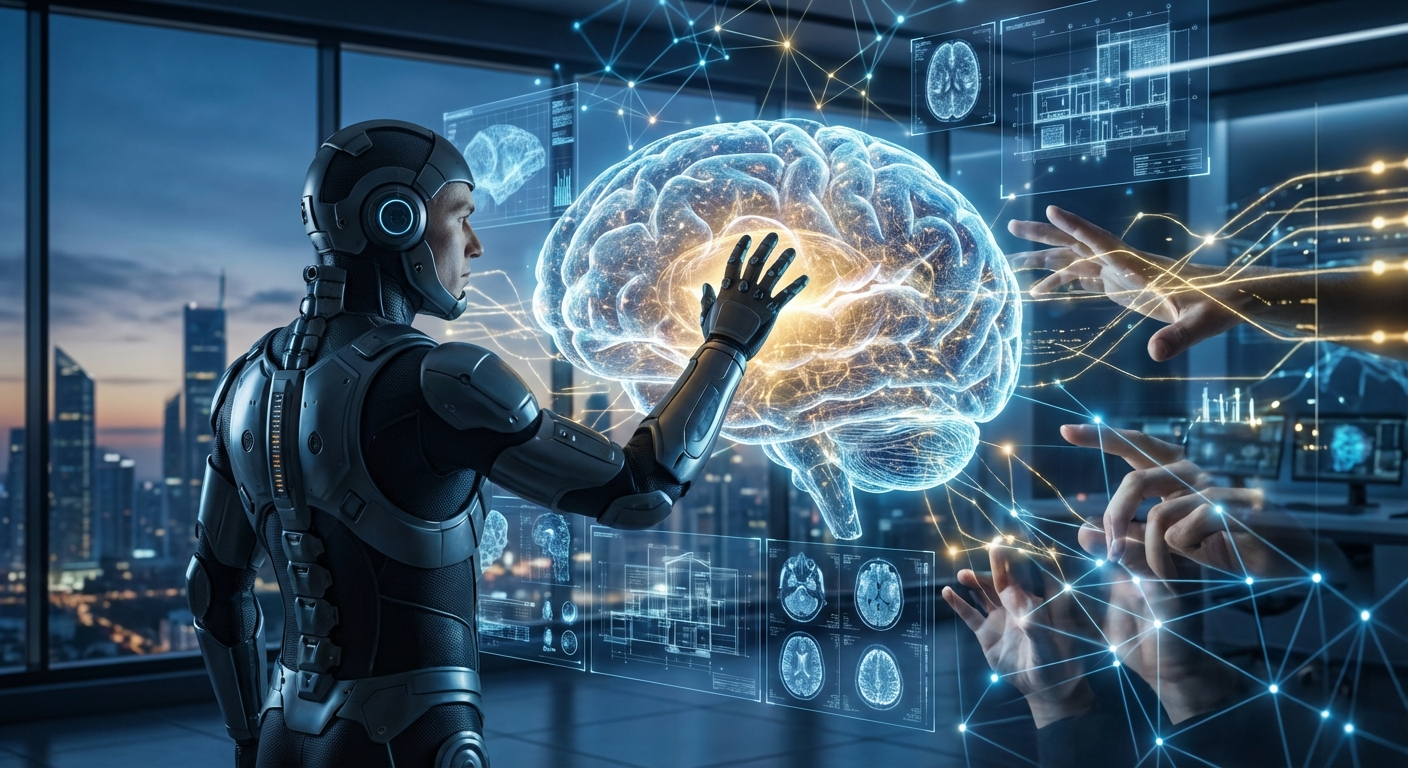
As we navigate the complexities of the 21st century, the collaborative model offered by Augmented Intelligence is poised to become indispensable. It shifts the narrative from a fear of AI dominance to an embrace of AI as a powerful partner, one that amplifies our human strengths and allows us to achieve more than ever before. When seamlessly integrated with the immersive capabilities of Extended Reality, Augmented Intelligence transcends traditional boundaries, creating intuitive, powerful, and deeply human-centric experiences. This is the true promise of intelligent systems: not to replace us, but to elevate us. The future of innovation, productivity, and human potential lies in this intelligent partnership. Ready to explore the tools that will power this augmented future? Discover the latest in XR technology and accessories today!
Explore New Arrivals at MetanexusXR!
User Reviews:
"Augmented Intelligence with AR has transformed our field operations. My team can now perform complex diagnostics with real-time AI guidance, dramatically cutting down repair times. Truly the future!" - Alex T., Senior Field Engineer
"As an educator, I've seen firsthand how AI-powered VR training revolutionizes learning. Students grasp concepts faster and retain more. It's personalized education on a whole new level." - Dr. Lena K., University Professor
Engaging Discussion Questions:
- What specific industry do you believe will see the most significant transformation from Augmented Intelligence combined with XR in the next five years?
- How do we ensure ethical guidelines and human oversight remain paramount as Augmented Intelligence systems become more sophisticated and integrated into daily life?
- Beyond professional applications, how do you envision Augmented Intelligence enhancing everyday personal experiences through AR or VR in the future?


