


The landscape of extended reality (XR) is rapidly evolving, with major players making significant strides towards a future where digital and physical realities seamlessly merge. This transformative period is perfectly encapsulated by the recent developments that are shaping the industry. From revolutionary hardware to groundbreaking software platforms, the progress is undeniable. This article delves into the exciting intersection of these advancements, examining how they converge to define the current Market Reality: Microsoft's Consumer Smartglasses, Apple Invests in Corning & Niantic Launches Lightship Beta. For those eager to explore the cutting edge of XR, MetanexusXR offers a curated selection of devices and accessories pushing these boundaries.
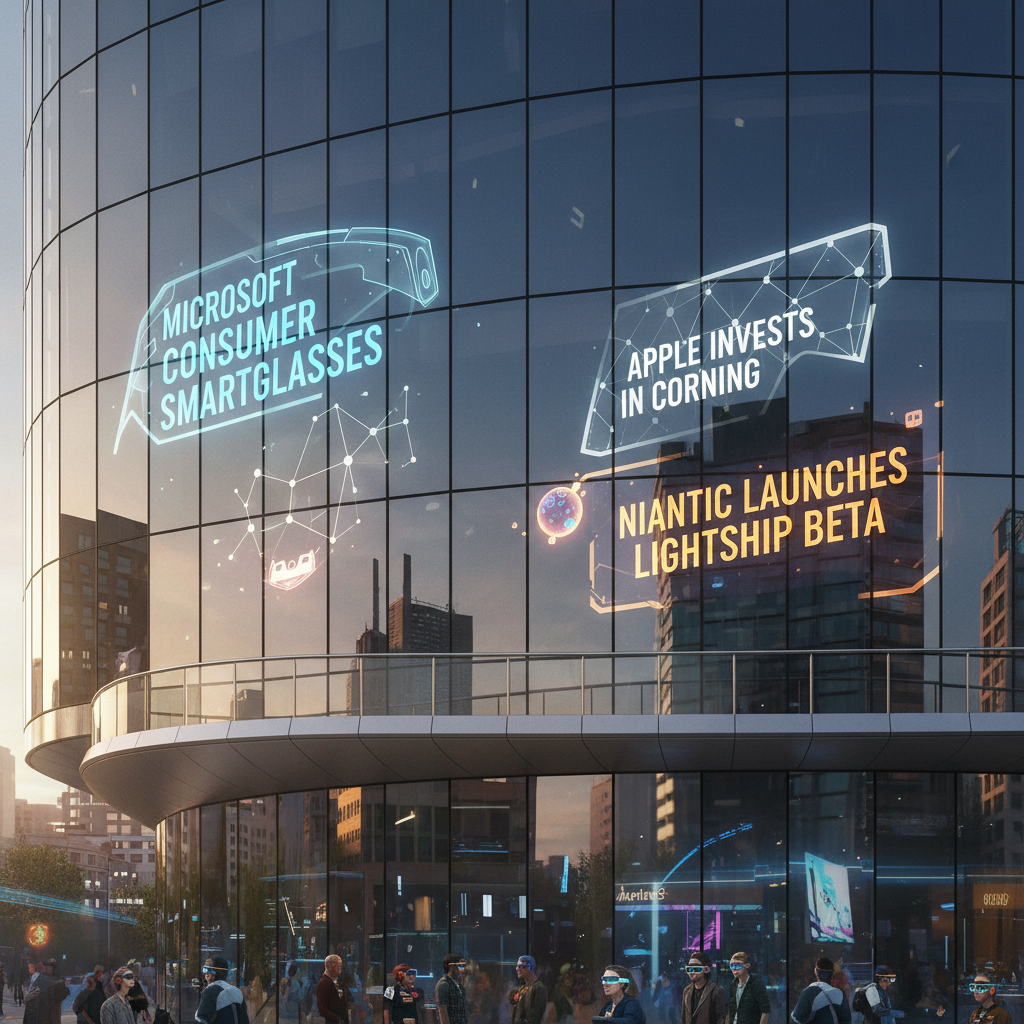
Unpacking the Market Reality: Microsoft's Consumer Smartglasses, Apple Invests in Corning & Niantic Launches Lightship Beta
Microsoft, a long-time pioneer in augmented reality with its HoloLens line, is now setting its sights on the consumer market with a new generation of smartglasses. Unlike their enterprise-focused predecessors, these upcoming devices are designed to be lighter, more stylish, and ultimately, more accessible for everyday users. Expected to launch around 2026, these consumer smartglasses aim to be a genuine replacement for smartphones, offering a ubiquitous computing experience that blends digital information with the real world.
Key technical specifications and features anticipated for Microsoft's consumer smartglasses include:
-
Advanced Display Technology:
Utilizing high-brightness MicroLED displays, these smartglasses are expected to deliver exceptional visual clarity and vibrant colors, crucial for outdoor visibility and immersive AR experiences. With brightness levels potentially ranging from 2500 to 4000 nits, digital overlays will remain crisp even in direct sunlight.
-
Expansive Field of View (FoV):
To enhance immersion and user comfort, these glasses are projected to offer a significantly wider field of view than many current AR devices, potentially reaching 70-80 degrees. This expanded FoV will allow for more natural interaction with augmented content, making digital objects feel truly present in the user's environment.
-
Robust Optical Engine:
At the core of their visual prowess will be advanced holographic waveguides or similar sophisticated optical systems, ensuring that virtual images are projected with minimal distortion and maximum clarity onto the user's view of the real world.
-
Seamless Connectivity:
Equipped with 5G and Wi-Fi 6E, the smartglasses will ensure ultra-low latency and high-bandwidth connectivity, critical for cloud-based XR applications, real-time communication, and immersive multiplayer experiences.
-
Powerful On-Device Processing:
A custom ARM-based System-on-Chip (SoC), likely a derivative of Qualcomm's Snapdragon XR platform, will power the device. This custom silicon will enable sophisticated on-device AI for spatial computing, context awareness, and efficient power management, allowing for extended battery life.
-
Intuitive Interaction:
Users can expect a range of interaction methods, including natural gesture controls, precise voice commands, and potentially even neural interfaces or compact ring controllers for nuanced input.
-
Integrated Ecosystem:
These smartglasses will deeply integrate with Microsoft's expansive ecosystem, including Microsoft Mesh for collaborative virtual spaces, Teams for enhanced communication, and Xbox cloud gaming for immersive entertainment. Productivity applications will also be seamlessly integrated, transforming how we work and interact.
The benefits of such a device are manifold. Imagine navigating a new city with real-time directions overlaid directly onto your view, collaborating with colleagues on a 3D model that appears in your living room, or playing an immersive game that interacts with your physical surroundings. This leap in consumer-focused AR hardware signifies a pivotal moment, ushering in an era where digital information becomes an intrinsic part of our perception. To enhance these experiences, exploring high-quality peripherals can make a difference; check out MetanexusXR's VR Accessories for innovative add-ons.
Apple's Strategic Investment in Corning and its Impact on the Market Reality: Microsoft's Consumer Smartglasses, Apple Invests in Corning & Niantic Launches Lightship Beta
While Microsoft focuses on the device itself, Apple is making strategic moves to secure foundational technologies for its own future XR endeavors. Apple's investment of $450 million from its Advanced Manufacturing Fund into Corning Incorporated is a clear signal of the importance of advanced glass technology in the next generation of computing. Corning, a world leader in precision glass, optical physics, and the fusion draw process, is pivotal in developing materials for high-performance displays and optical components.
This investment ensures that Apple will have access to cutting-edge glass for its rumored AR/VR devices, such as the highly anticipated 'Apple Glass' or subsequent headsets. The implications are significant:
-
Enhanced Durability:
Corning's expertise in materials science will lead to even more durable, scratch-resistant, and drop-resistant glass, essential for devices that will be worn daily and exposed to various environments.
-
Superior Optical Quality:
For AR, the clarity and purity of the glass are paramount. Corning's ultra-thin, high-purity glass will be crucial for creating high-fidelity waveguides and lenses that minimize distortion and maximize light transmission, delivering crystal-clear augmented overlays.
-
Manufacturing Innovation:
The investment also supports advancements in US-based glass manufacturing capabilities, fostering innovation and securing a robust supply chain for critical components.
Apple's focus on the fundamental building blocks of AR hardware underscores the industry-wide commitment to delivering not just functional, but also premium and robust XR experiences. The partnership with Corning is a testament to the fact that the future of XR isn't just about software and processing power, but also about the physical materials that bring these digital worlds to life. For a comprehensive look at the range of products shaping this future, visit MetanexusXR's full collection.
Niantic Lightship Beta: Empowering the Real-World Metaverse
Beyond hardware advancements, software platforms are equally crucial in shaping the XR landscape. Niantic, the company behind the global phenomenon Pokémon GO, has officially launched the beta for its Lightship Augmented Reality Development Kit (ARDK). Lightship is a comprehensive platform designed to empower developers to create truly immersive, location-based AR experiences that deeply interact with the real world.
Key features of the Niantic Lightship Beta include:
-
Real-Time Mapping (VPS - Visual Positioning System):
Lightship allows AR applications to understand and map the physical environment in real-time. This enables persistent AR experiences tied to specific physical locations, meaning a digital object placed in a park today could still be there tomorrow for others to discover.
-
Occlusion:
A critical feature for realistic AR, occlusion ensures that digital objects correctly appear in front of or behind real-world objects, making them feel like they genuinely belong in the environment.
-
Semantic Segmentation:
The platform's ability to understand different surfaces (e.g., distinguishing between ground, sky, water, or buildings) allows AR experiences to interact intelligently with the environment, for example, making a virtual character walk realistically on a sidewalk or swim in a lake.
-
Multiplayer AR:
Lightship facilitates shared AR experiences, allowing multiple users in the same physical space to interact with the same digital content simultaneously, fostering social and collaborative AR applications.
-
Depth Sensing:
By leveraging device cameras, Lightship creates a 3D mesh of the environment, enhancing the realism of interactions between virtual objects and physical surroundings.
Niantic's vision for Lightship is to power a 'real-world metaverse,' where digital content is not just overlaid but deeply integrated into physical spaces, creating a new layer of digital interaction within our everyday lives. This democratization of advanced AR development tools will foster an ecosystem of innovative location-based applications, from games and entertainment to educational and utility tools. The revenue share model offered by Niantic provides a clear path for developers to monetize their creations, further accelerating the growth of this real-world metaverse. As these immersive technologies become more prevalent, the need for robust and comfortable VR accessories for prolonged use will also grow.
The collective advancements highlighted by the Market Reality: Microsoft's Consumer Smartglasses, Apple Invests in Corning & Niantic Launches Lightship Beta paint a vivid picture of a future where XR is not just a niche technology but an integral part of our daily lives. From Microsoft's ambitious consumer hardware and Apple's foundational material science investments to Niantic's powerful AR development platform, each piece contributes to building a more immersive, interactive, and connected world. As these technologies mature and converge, we can anticipate a paradigm shift in how we work, play, and connect.
Stay ahead of the curve and be among the first to experience these groundbreaking innovations. Explore the latest in XR devices and accessories that are shaping this future. Discover New Arrivals at MetanexusXR Today!
User Reviews:
"Absolutely fascinating! The breakdown of Microsoft's smartglasses specs has me genuinely excited for 2026. The potential for everyday utility is immense. Can't wait to see how it integrates with Xbox!" - XR_Enthusiast_78
"As a developer, Niantic's Lightship Beta sounds like a game-changer. Real-time mapping and semantic segmentation will unlock so many possibilities for location-based AR. This article perfectly captured its significance." - CodeCrafter_AR
Engaging Discussion Questions:
- How do you envision Microsoft's consumer smartglasses changing your daily routine if they successfully replace smartphones?
- What specific real-world AR applications are you most excited to see developed using platforms like Niantic Lightship?
- Beyond durability, what other innovations do you think Apple's investment in Corning will bring to future XR devices?


